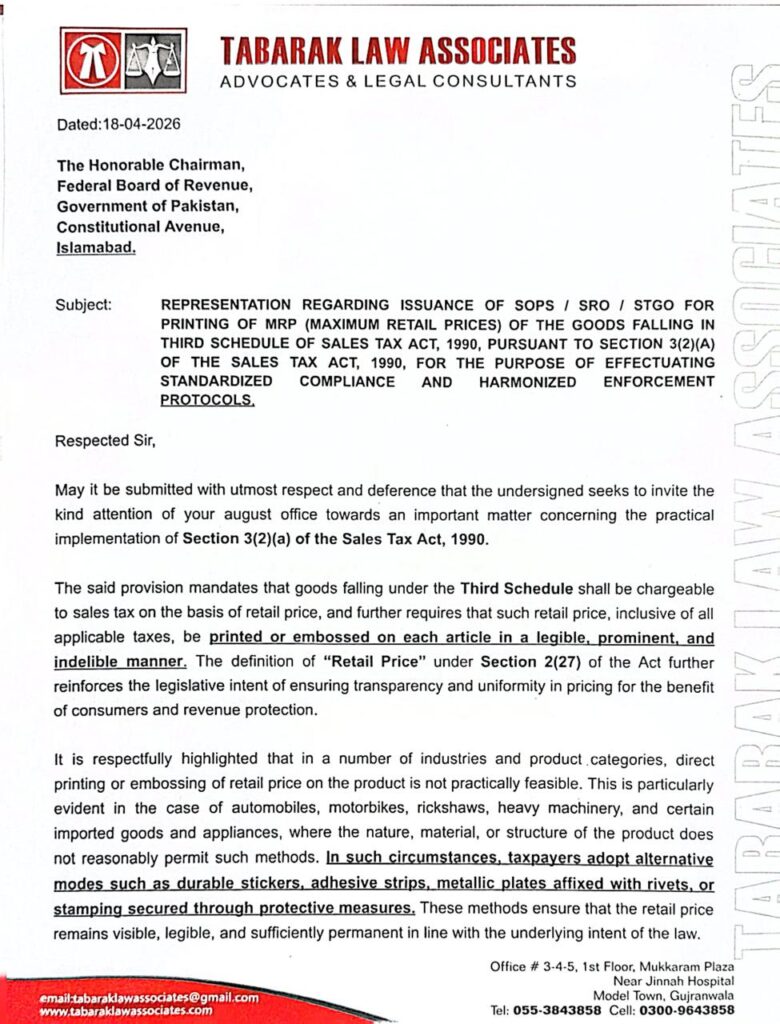

Dated: 18th April 2026
Tabarak Law Associates — Advocates & Legal Consultants has formally submitted a representation to the Honorable Chairman, Federal Board of Revenue (FBR), Government of Pakistan, regarding the practical implementation of Section 3(2)(a) of the Sales Tax Act, 1990.
The Issue
The said provision requires that goods falling under the Third Schedule shall have their retail price — inclusive of all applicable taxes — printed or embossed on each article in a legible, prominent, and indelible manner. However, for many product categories such as automobiles, motorbikes, rickshaws, heavy machinery, and certain imported appliances, direct printing or embossing is not physically feasible.
In such cases, taxpayers resort to alternative methods, including durable stickers, adhesive strips, metallic plates affixed with rivets, or protective stamping — all of which fulfill the legislative intent of visibility and permanence.
The Problem
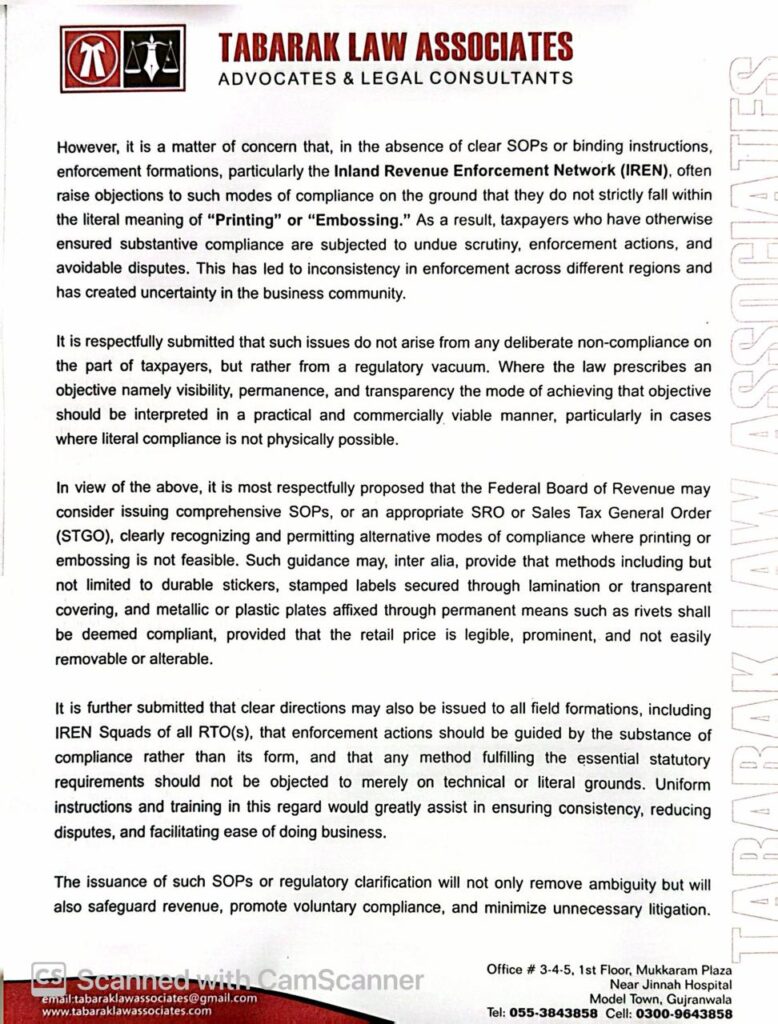
In the absence of clear SOPs or binding instructions, enforcement formations — particularly the Inland Revenue Enforcement Network (IREN) — have been raising objections to these alternative methods on the ground that they do not strictly fall within the literal meaning of “Printing” or “Embossing.” This has led to inconsistent enforcement across regions and created unnecessary uncertainty for compliant businesses.
Our Proposal to FBR
Tabarak Law Associates has respectfully proposed that FBR issue comprehensive SOPs, an SRO, or a Sales Tax General Order (STGO) that:
- Formally recognizes alternative MRP-marking methods where direct printing/embossing is not feasible
- Declares durable stickers, laminated labels, and riveted metallic/plastic plates as compliant — provided the price is legible, prominent, and not easily removable
- Directs all field formations, including IREN Squads of all RTOs, to base enforcement on the substance of compliance rather than its literal form
Conclusion
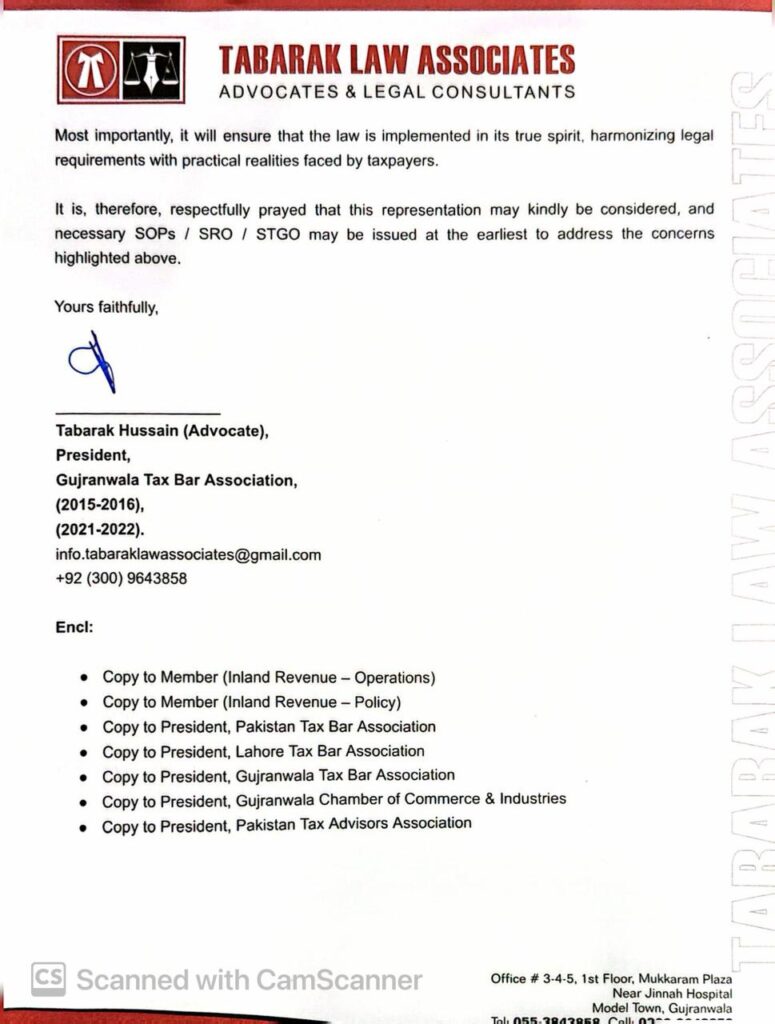
This representation has been widely circulated to the Member (Inland Revenue – Operations), Member (Inland Revenue – Policy), Pakistan Tax Bar Association, Lahore Tax Bar Association, Gujranwala Tax Bar Association, Gujranwala Chamber of Commerce & Industries, and Pakistan Tax Advisors Association.
Such regulatory clarity will remove ambiguity, promote voluntary compliance, safeguard revenue, and minimize unnecessary litigation — ensuring the law is implemented in its true spirit.
For legal consultation regarding Sales Tax matters, contact Tabarak & Co. at UAN 055 3843858 or visit www.tabarakandco.com